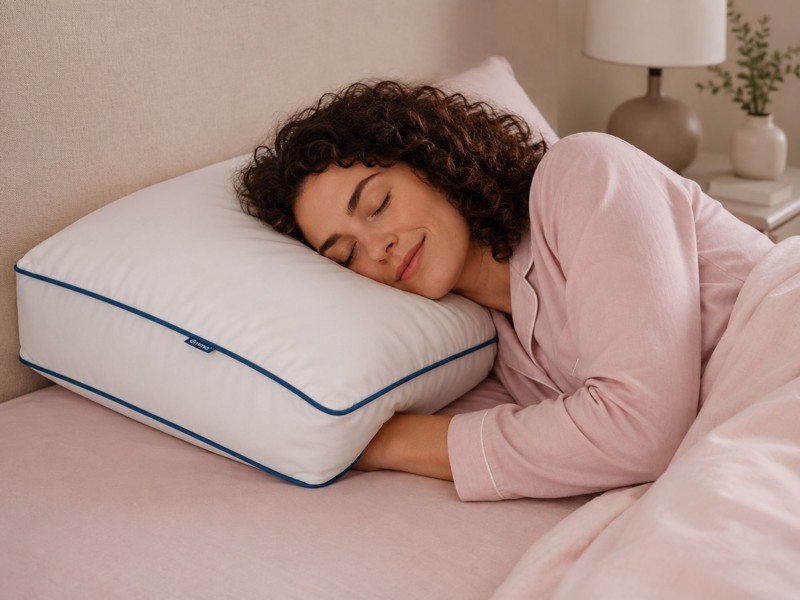
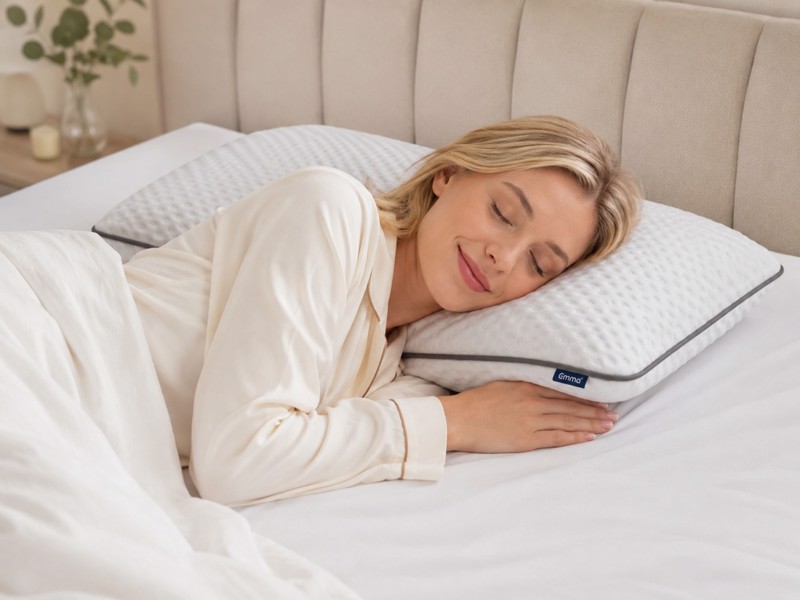
Side sleeping is the most common sleep position in the UK - and it is the position that puts the most specific demand on a pillow. When you lie on your side, there is a gap between the side of your head and the mattress surface. The pillow's job is to fill that gap precisely - keeping your head level, your spine straight, and your neck in a neutral position. Too low and your head drops. Too high and it tilts upward. Either way, the neck muscles work through the night to compensate, and you wake up stiff. The right pillow for a side sleeper has enough height to fill the head-to-shoulder gap, and enough support to hold that position without collapsing. Our range of side sleeper pillows covers memory foam, latex, contour, and adjustable options designed to do exactly that. Free delivery on orders over £100 and expert advice seven days a week.
Browse the full side sleeper pillow range below, or speak to our team for a personal recommendation based on your shoulder width and fill preference. We are available seven days a week on 01928 242829.
Most people choose a pillow based on feel - soft or firm, thick or thin - without connecting that choice to how they actually sleep. But sleep position is the most important factor in pillow selection, and getting it wrong is one of the most common causes of the neck stiffness, shoulder tension, and disrupted sleep that people wrongly assume they just have to live with.
Here is why side sleeping is different from other positions, and what that means for the pillow you need.
When you lie on your back, your head rests fairly close to the mattress - the pillow needs to support the natural cervical curve without pushing the chin forward. When you lie on your front, the head is almost flat - the pillow needs to be as low as possible to avoid twisting the neck.
Side sleeping is different because of geometry. Your shoulder is between the mattress and your head. The distance from the mattress surface to the side of your head - across the shoulder - is typically 10 to 15cm depending on your build and shoulder width. The pillow needs to bridge that entire gap. If it does not, your head drops toward the mattress and your neck bends downward. If it is too thick, your head is pushed upward and your neck bends the other way. Both create muscle strain that builds up over a full night.
This means a pillow that is excellent for a back sleeper - a medium loft, medium firmness option - will often be too low for a side sleeper. And a pillow that suits a narrow-shouldered person may not give enough support for someone broader across the shoulders.
The right pillow for a side sleeper is higher than you might expect, firm enough to hold its position under the weight of your head, and stable enough not to compress down to nothing by the middle of the night. For a full guide to pillow selection across all positions, see: The Ultimate Guide to Finding Your Right Pillow.
| Requirement | Why It Matters | What to Look For |
|---|---|---|
| Higher loft | The pillow must fill the gap between the mattress and the side of your head - a gap created by the width of your shoulder. This gap is larger than most people assume, typically 10 to 15cm. A low or medium-loft pillow designed for back sleepers will leave a side sleeper's head dropping. | Look for pillows described specifically for side sleepers or with high loft or firm profiles. If you have broader shoulders, err toward the higher end of the range. |
| Consistent support | A pillow that starts at the right height but compresses to half that height by 3am is not serving its purpose. The pillow must hold its loft under the sustained weight of your head throughout the night. | Memory foam and latex hold their shape more consistently than hollow fibre or down. If you find yourself repositioning your pillow during the night, this is usually why. |
| Shoulder pressure relief | Your lower shoulder - the one you are lying on - needs space. If the pillow is too wide or too thick at the shoulder end, it can push upward against the shoulder rather than just supporting the head. Some ergonomic pillow designs have a recessed shoulder zone to address this. | Ergonomic or contour pillows shaped for side sleeping address this specifically. A standard rectangular pillow works well too if the loft is correct - the shoulder position is mainly determined by the mattress. |
| Neutral neck alignment | The goal is for your neck to be in a straight line with the rest of your spine - not bent up, not bent down. Your ear should be roughly aligned with your shoulder when you are properly supported. | If you wake with stiffness on the side you slept on, the pillow height is usually the first thing to address. |
Most side sleepers with the wrong pillow experience at least one of these. They are easy to identify once you know what to look for.
Signs your pillow is too low:
Signs your pillow is too high:
If you change position frequently during the night - switching between sides or rolling to your back - an adjustable-fill pillow lets you tune the height to find what works for you before committing. Several options in this range have removable fill for exactly this reason.
Not all fills suit side sleeping equally. Here is a plain guide to how the main options perform for this position.
| Fill Type | How It Performs for Side Sleeping | Best For |
|---|---|---|
| Memory foam (solid) | Maintains a consistent loft throughout the night and contours closely to the head and neck. Does not compress or shift during sleep. Can retain heat - look for open-cell or cooling variants if you sleep warm. | Side sleepers who want reliable, unchanging support without repositioning the pillow at night |
| Memory foam (contour/ergonomic) | Shaped specifically for the head and neck, often with a raised side-sleeping zone and a recessed area for the shoulder. Designed to maintain alignment without adjustment. | Side sleepers who want targeted support and are comfortable sleeping in a consistent position |
| Latex | Naturally resilient and springy - it compresses under weight and returns immediately rather than slowly moulding like memory foam. Holds its loft very well. Naturally hypoallergenic. Breathes better than standard memory foam. | Side sleepers who prefer a more responsive, springy feel rather than the sinking quality of memory foam, or those who sleep warm |
| Adjustable / hybrid | Contains a removable or adjustable fill that lets you add or reduce material to find your ideal height. Particularly useful if you are unsure of your ideal loft or switch between sleeping positions. | Those new to position-specific pillows, combination sleepers who spend time on their side and back, those with partners who need different heights |
| Hollow fibre / microfibre | Can be plumped to a higher loft but compresses more readily under sustained pressure than foam or latex. Requires more frequent fluffing and repositioning. | Those who prefer a softer, more traditional pillow feel and are willing to adjust during the night |
One factor that most pillow guides overlook is that the right loft for a side sleeper is not universal - it depends on how wide your shoulders are. A broader-shouldered person has a larger gap between the mattress and the side of their head, and needs a higher-loft pillow than a narrower-shouldered person sleeping on the same mattress.
| Build | Approximate Gap | What This Means for Loft |
|---|---|---|
| Narrower shoulders | Around 10 to 11cm | A standard high-loft pillow may be sufficient. Avoid going too thick or the neck will tilt upward. |
| Average shoulders | Around 12 to 13cm | Most pillows marketed specifically for side sleepers are designed around this range. |
| Broader shoulders | Around 14 to 15cm or more | A standard side-sleeper pillow may not give enough height. Look for extra-firm or large-format options, or consider a layered or adjustable pillow where height can be increased. |
The mattress also plays a role. A softer mattress allows the shoulder to sink in slightly, reducing the gap. A firmer mattress allows less sinkage, increasing it. If you have recently changed mattress and find your pillow no longer feels right, this is often why.
One of the most common complaints from side sleepers is waking with shoulder or arm discomfort on the side they slept on. This is worth addressing separately because a pillow can only solve part of the problem.
If the lower arm goes numb, it is usually because the body weight is compressing the shoulder and restricting circulation - a mattress with better pressure relief at the shoulder point addresses this more directly than a pillow change. A mattress topper with memory foam or latex at the surface can help significantly here.
If the neck or upper shoulder is stiff, the pillow is more likely the issue - and height is the first thing to adjust.
If both are present, it is usually worth looking at both the pillow and the mattress surface together rather than assuming one solution covers everything. Our team can help you work through this if you are not sure where the problem is.
| Item | Included? |
|---|---|
| Pillow | Yes - always |
| Removable washable cover | On most models - check individual listing |
| Care guide | Yes - always included |
| Guarantee | Yes - 1 to 3 years depending on brand and model. Check individual listing. |
| Pillow protector | No - sold separately. Recommended to protect the pillow and extend its life. See our pillow protectors. |
Always check the individual product listing for full details before purchasing.
| What We Offer | Why It Matters to You |
|---|---|
| 50+ years of expertise | Honest advice on loft, fill type, and shoulder width - the three things that actually determine whether a side sleeper pillow works for you |
| Memory foam, latex, contour, and adjustable options | A range that covers every fill preference and support style for side sleepers |
| Cooling options in the range | Side sleeping on a memory foam pillow can retain heat - cooling and open-cell foam options address this specifically |
| Free UK delivery on orders over £100 | No hidden delivery charges on the vast majority of orders. Some remote postcodes may incur a surcharge - see our delivery page for details. |
| Price Promise Guarantee | We'll match any like-for-like price you find elsewhere |
| Interest-free finance available | Spread the cost on eligible orders - see our finance page for terms |
| Expert advice, 7 days a week | Real people via phone, chat, or in-store - no scripts, no pressure |
| Rated Excellent on Trustpilot | Real feedback from verified customers across thousands of orders |
Not sure whether memory foam, latex, or an adjustable pillow suits your side sleeping position and shoulder width? Our team can help you work through it quickly. Chat online, call us, or visit our showrooms in Cheshire and Greater Manchester. We're open seven days a week.
| How to Reach Us | What to Expect |
|---|---|
| Live chat | Fast responses for quick questions. Available during opening hours. |
| Phone - 01928 242829 | Speak directly with a sleep expert. Best for matching pillow height, fill type, and support level to your specific shoulder width and sleep position. |
| In-store (Cheshire / Greater Manchester) | Try pillow options in person. See our store locations. |
| Help Centre | Buying guides and FAQs available 24/7. Visit our help and advice section. |
| Question | Answer |
|---|---|
| Why do side sleepers need a different pillow? | Side sleeping creates a physical gap between the mattress and the side of the head - the distance across the shoulder. A pillow for a side sleeper must fill that gap precisely to keep the head level with the spine. Too low and the neck drops toward the mattress. Too high and it tilts upward. Both create muscle strain that builds up across a full night. Most general-purpose pillows are not high or firm enough for this. |
| What loft does a side sleeper pillow need? | Most side sleepers need a loft of around 10 to 15cm, depending on shoulder width. Broader shoulders create a larger gap and need a higher pillow. The mattress also matters - a softer mattress allows the shoulder to sink in, reducing the gap slightly. If in doubt, an adjustable pillow lets you add or remove fill until the height is right. |
| Is memory foam good for side sleepers? | Yes - solid memory foam is one of the best options for side sleeping because it holds its loft consistently under sustained pressure throughout the night. Unlike hollow fibre, it does not compress to a fraction of its original height by the middle of the night. The main consideration is temperature - standard memory foam can retain heat, so look for open-cell or cooling variants if you tend to sleep warm. |
| Is latex good for side sleepers? | Yes. Latex is naturally resilient - it compresses under the weight of the head and returns to its full height immediately, rather than moulding slowly like memory foam. It holds its loft very well throughout the night and breathes better than standard memory foam. It is a good option for side sleepers who prefer a more responsive, springy feel. |
| What if I switch between sleeping on my side and my back? | An adjustable-fill pillow is the most practical solution for combination sleepers. You can tune the height to a level that works reasonably well for both positions, or reduce the fill slightly to create a compromise between the higher loft needed for side sleeping and the lower loft suited to back sleeping. Several options in this range are adjustable for exactly this reason. |
| Could my pillow be causing my shoulder pain? | Partly, possibly. If you wake with a stiff neck on the side you slept on, pillow height is a strong first suspect - too low is the most common issue. If your bottom arm goes numb, the cause is more likely pressure on the shoulder from the mattress, where a mattress with better pressure relief at the shoulder zone makes more difference than the pillow alone. If both symptoms are present, both the pillow and the mattress surface may need addressing. Our team can advise. |
| How many pillows should a side sleeper use? | Usually one well-chosen pillow is better than two poorly chosen ones. Stacking two pillows is a sign the current pillow is not the right height - the stack shifts during the night and provides inconsistent support. A single pillow with the correct loft for your shoulder width is the more reliable solution. Some side sleepers also place a pillow between their knees to reduce hip and lower back tension - this is separate from the head pillow. |
| Do you offer free delivery on side sleeper pillows? | Yes, free UK delivery is included on orders over £100. Some individual pillows below this threshold may have delivery charges - check the individual listing. Some remote postcodes may incur an additional charge. See our delivery page for full details. |
| Can I buy a side sleeper pillow on finance? | Yes. Interest-free finance is available on eligible orders. See our finance page for full details on terms, eligibility, and how to apply. |